ISO Compliance in the UAE: A Practical Guide
Wiki Article
The Reasons Uae Businesses Are Fasting To Be Iso Certified In 2026
When you are in every procurement discussion in the UAE right now and ISO certification will be mentioned within the first few minutes. What was once an attractive credential for larger companies has turned into a essential requirement in construction, healthcare, logistics, food production, and technology. The rate that local businesses are pursuing certification has picked up dramatically over the past few years.Government contracts are driving much of the Demand
The bulk of the current push comes directly from semi-government and government tendering requirements. A majority of public sector contracts across the Emirates now require an ISO certification as a mandatory prequalification, not an optional additional requirement. This signifies that companies who don't have one basically excluded from tendering before the price or capability is even part of the discussion.
International Trade Partners Expect It as Standard
The UAE's position as a regional logistics and trade hub has meant that a substantial portion of local businesses interact with international partners. And these organizations increasingly use ISO certification as a trust signal rather than a distinguishing factor. The European or North American buyer evaluating a business based in the UAE is likely to choose the supplier based on whether they have a recognized management system certification is in place, since it's a good reference point regardless of how well they know the local market.
Free Zones are actively encouraging the Certification
Many of the largest UAE free zones are now promoting certification as a part of their business formation packages realizing that certified tenants have a tendency to attract more clients and are more successful in expanding. This encouragement of the institutional level, combined with genuine competitive pressure, has pushed certification from an option for a specialized group to one that is that is more similar to the standard of business hygiene.
Insurance and Risk Considerations Are Affiliating a Growing Role
Insurers operating in the UAE in the market are taking into account management system certification into their risk evaluations, especially in the fields of construction and manufacturing where quality and safety failures create significant liability risks. A certification of a safety or quality management system provides insurers with an established foundation for risk pricing, and some are now offering better rates to those with certifications in the process.
The Cost of Certification has been lowered
A heightened competition between certification organizations and consultants operating in the UAE has reduced costs considerably in comparison to a decade ago, allowing certification to small and medium-sized firms that had thought it was just for large corporates. This shift in pricing opens the door for many more companies looking to obtain certification for first time.
Different Standards Suit Different Businesses
It is not every company that requires the same certification in order to understand which standard actually applies is often the initial hurdle. A construction company's requirements for safety management look very different from the priorities of a software business concerning security of data, which is why there is a growing demand across a broad range of guidelines rather than sticking to just one.
What does this mean for businesses? Still unsure
For companies still weighing up the merits of certification what is actually happening in 2026 is that the issue is no longer whether other competitors have certification to how many possibilities are missing with certification. Getting started typically begins with a gap evaluation against the relevant standard. This is followed by a structured execution period prior to a formal external audit. And the entire process is a lot simpler than even five years ago.
The Talent Market is Responding Too
As certification is becoming more vital to the way UAE companies function, there is a real local talent marketplace has developed around the quality, environmental and safety management jobs, with more specialists in possession of lead auditor accreditation and certifications for implementation than previously. This has made it significantly easier for companies to employ internal personnel who are able to maintain an effective management system for a long time in the aftermath of certification program finishes, rather than the needing to rely entirely on external consultants for the duration of time.
Multinational Companies Are Setting the Regional Tone
Many of the multinational companies that have in regional and Middle East headquarters out of the UAE bring global certification requirements to them, in turn, they expect local suppliers or partners to meet similar standards. This has resulted in a influence on local businesses supplying into these multinational supply chains often discover that certification requirements are escalating down in response to client demands that originate somewhere outside the UAE within the country.
It is increasingly being viewed as a Growth Enabler, In addition to Compliance
Perhaps the most significant change in perception over the last few years is that more UAE businesses are now viewing certification as something that actively enhances growth, by opening potential for tender eligibility, as well as international partnership opportunities, rather than treating it solely as an expensive compliance expense. This revision has made this expense much more easily to justify internally since it links directly to revenue-generating opportunities instead of being a part of the budget for compliance.
What can we expect in the coming years? Beyond
Given the current course it's reasonable to anticipate that ISO certification to be able to move from a purely competitive edge to a full access to markets requirement across an increasing variety of UAE sectors over the next years. Businesses that have a head start on the trend instead of being patient until certification becomes necessary typically find the process less stressful and the resulting market position will be much more competitive.
How Long the Whole Process generally takes
The full journey between the initial gap examination to certification is typically from 3 to 9 months depending on business size and current process maturity and the speed at which internal teams can be able to implement required modifications. Organizations under intense pressure frequently try to shorten the timeframe significantly, but rush the implementation process can develop a management framework that does not perform well at the first audit, making a sensible timeframe a real investment.
Ultimately, the surge in ISO certifications throughout the UAE represents a market that is no longer treating quality and safety as a preference of the internal staff and is now treating it as an essential part of running business in a professional manner, locally as well as internationally. For any business who is ready start, the best next stage is to have an honest conversation with a certified certification body or expert about which standard is in line with current business practices and customer expectations, rather than guessing from what a competitor is displaying on their website. None of this momentum shows signs of slowing down in the present moment an ideal time for companies still contemplating certifications to go from contemplation to decision. View the recommended ISO Certification Company UAE for more tips.
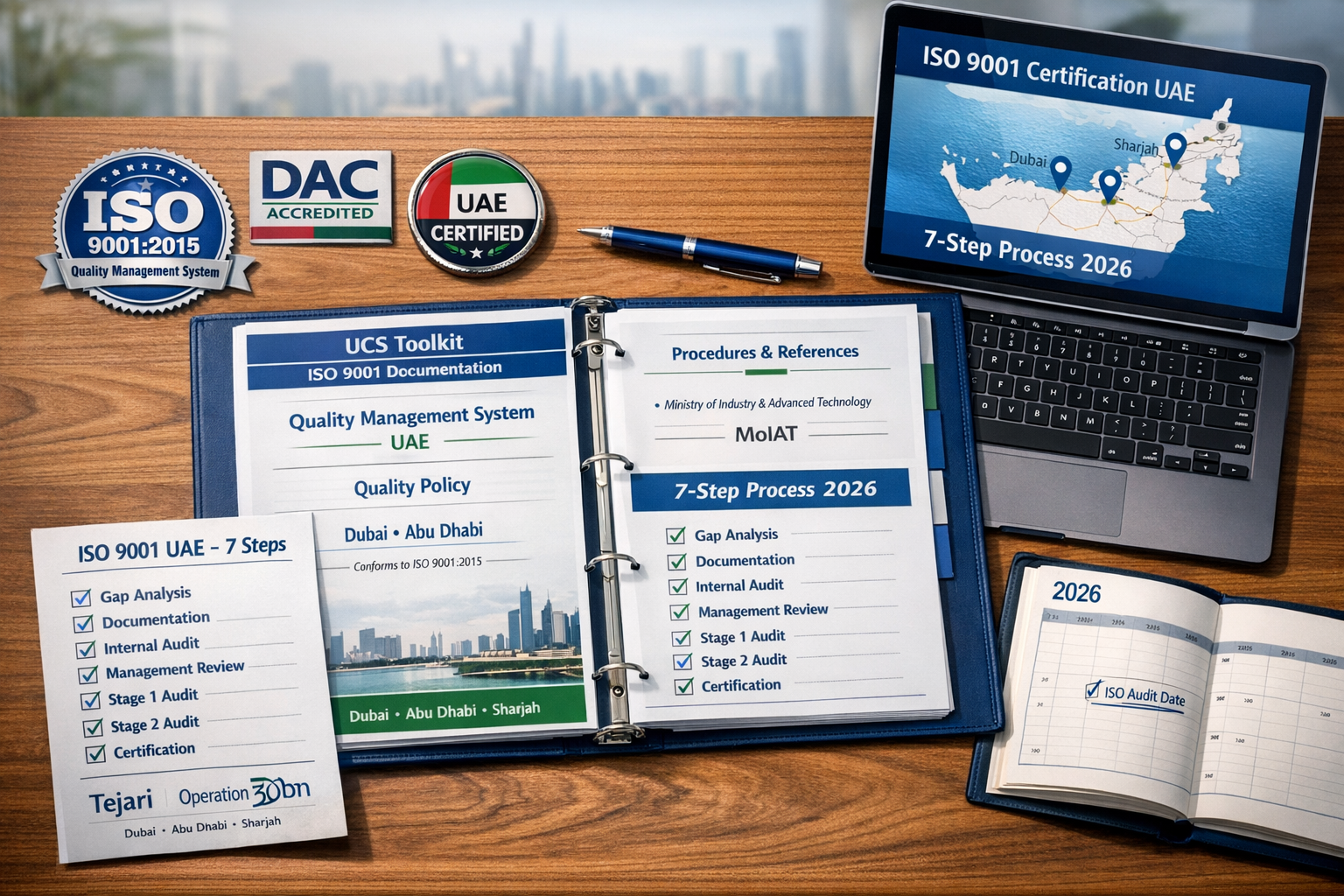
ISO 9001 Explained: Quality Management for UAE Businesses
ISO 9001 remains the most widely recognised management system standard across the world, and with good reason. It's based on the practical idea, that consistent quality comes from consistent, properly managed processes rather than intentions alone. For UAE companies who are thinking of obtaining certification, knowing what the standard actually asks for helps demystify a process that often sounds more complicated than it actually is.What ISO 9001 Is Actually Built Around
Fundamentally, ISO 9001 asks a business to establish its most important processes and understand how they interact and assess whether they're working, and improve them by systematically improving them over time. Instead of specifying how a business should function, it provides a framework to ensure that whatever method that a company takes should be logical, documented when it is necessary, and strictly adhered to.
What is the reason UAE Businesses Want to Get It?
Beyond the value of reputational the ISO 9001 certification, numerous UAE enterprises are looking to achieve ISO 9001 because government and tenders for private sector companies increasingly include it as the prequalification criteria. Beyond the fact that it is a requirement and implementing it properly often find genuine tangible benefits to their operations, like less errors, a clearer system of accountability as well as a more systematic process for dealing with complaints from customers.
The Role of Top Management
One area the standard is particular about is real management involvement, as opposed to quality management being delegated entirely to a single compliance official who is unaffected from actual decisions. Auditors will specifically look for evidence that top leadership is aware and actively participates in the quality management system rather than just approving on it.
This is a key element of the Modern Standard
The current version of ISO 9001 places considerable emphasis on identifying risk and opportunity pertinent to a particular business's setting, rather that applying general guidelines, regardless of the specifics. This means a UAE construction firm and an UAE software company, even though both certified under the same standard are likely to have significantly different quality management processes showing their distinct risk profiles.
Customer Focus is evident throughout the Standard
ISO 9001 repeatedly returns to the notion that quality involves meeting the customer's requirements as well as expectations. It's not merely internal efficiency metrics. Companies that adopt the standard are expected to have genuine mechanisms that can help customers understand what they want and how they're satisfied, instead of assuming internal quality inspections alone will provide the full picture.
The Certification Process Itself
After the implementation of the required processes and documents, certification involves an external inspection that occurs in two steps. The first stage is to examine the documentation and readiness, then verifying that the system is properly operating as described. This is followed by yearly surveillance audits and a full reconcertification audit around every three years, to check ongoing conformity.
Common Misconceptions - Worth Clearing Up
A common misconception is ISO 9001 requires enormous volumes of documentation, but the actual version has reduced the necessity of documentation significantly in comparison to earlier versions, focusing instead on showing genuine process control. Another misperception is that certifications guarantee the quality of products directly, but in actual fact, it proves that a business has a consistent management system to manage quality, which is a distinct but nevertheless a useful thing.
How It Differently Applyes Across Industries
A construction company which has implemented ISO 9001 will focus heavily on project handover and subcontractor administration, whereas a professional services firm could concentrate heavily on client interaction processes in addition to knowledge management. Its real-time flexibility across various sectors is its reason for being relevant over a vast array of UAE industries that span from manufacturing to retail and consulting.
The role of continuous improvement
ISO 9001 doesn't treat quality as a single goal instead, it's a continuous process of evaluating effectiveness, identifying potential areas to enhance, and implementing improvements effectively. Companies that embrace this continual improvement mindset, rather than focusing on certification as a singular event, will reap an array of long-term and meaningful operational benefits from the standard.
Preparing Your Team in the Cultural Shift
Perhaps the most overlooked aspect during ISO 9001 implementation is the actual change in culture that's required, shifting away from individual-dependent, informal methods of working to more organized, consistent processes that don't solely rely on one person's memory or judgment. Prepare employees for this shift and educating them on the real advantages rather than treating it simply as a compliance task greatly improves the speed at which Implementation goes.
How do you know that an investment is likely to Pay Off
Firms that implement ISO 9001 thoughtfully, rather than simply the exercise of completing paperwork to meet an external standard, tend to notice that the investment pays off due to fewer mistakes repeated over time, improved internal accountability, as well as the foundation is stronger to scale operations as the company grows. The benefits are far beyond the certification in and of itself.
Where and How ISO 9001 Interacts With Customer Complaints Specifically
The standard requires businesses to have a logical, systematic process for handling customer complaints and feedback. The standard requires businesses to view each issue as a piece of information that must be fed back into improvements to the process, rather than being ignored or resolved. UAE companies that have built this feedback loop properly often have it become one of the most useful components of their management system in addition to its importance to meet the audit.
For UAE enterprises who want to know if ISO 9001 is worth pursuing, the honest answer usually is based on whether the business truly desires more consistent, better-managed processes, since the certification itself basically a formal endorsement of the fundamental operating discipline. For UAE enterprises that are genuinely interested in improving their practices rather than just obtaining certification, ISO 9001 offers a internationally recognized, tested process for making the change gradual rather than haphazard. The process does not require the elimination of the practices that are already working well within the business, as ISO 9001 is fundamentally about improving and enhancing good practices rather than replacing it wholesale using a new and untested system. If it is approached this way the certification is a natural extension of good management, not being a burden external to the company. It is, in the end an approach based on general sense and a consistent application rather than anything that is mysterious. That more than anything else is what gives it real consideration. Few investments offer as an extensive, long-lasting and lasting operational value. Really worth the time and effort it takes to make the right choice. See the recommended ISO 45001 Certification for more examples.
